
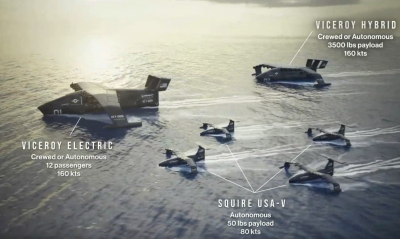
REGENT Craft, the developer and manufacturer of Seaglider vessels and a trusted partner of the U.S. Marine Corps, will be making seagliders for the US marines. REGENT has a $10 billion commercial backlog. They will make REGENT Defense Seaglider vessels at its headquarters in Rhode Island.
REGENT’s proprietary hydrofoiling wing-in-ground-effect(WIG) Seaglider design offers an unmatched combination of high-speed, long-range, and low-signature capabilities — all at significantly reduced costs compared to legacy transportations solutions. These advantages directly address the tyranny of distance often seen in littoral operations, where resupply and transport across vast ocean stretches has historically been difficult.
It could fly 12 marines 1,400 nautical miles at up to 160 knots using a hybrid power version. It is 30dB quieter than an aircraft or helicopter. They can make drone versions as well. Seagliders have an electric version with 160 nautical mile range with existing battery technology. New battery can upgrade to over 400 nautical mile range with next generation battery technology.
Panoramic view of Nha Trang bay in Vietnam
The commercial Viceroy Seaglider vessel already has a payload of 3,500 lbs and can travel at speeds up to 160 knots (180 mph) for routes up to 160 nautical miles (180miles) in the all-electric model and up to 1,400 nautical miles (1,600 miles) in the hybrid model. The autonomous hybrid Squire Seaglider vessel has a payload of 50 lbs and can travel at speeds of up to 70 knots (80 mph) for routes more than 100 nautical miles (115 miles).
REGENT Seaglider vessels will be manufactured in Rhode Island, U.S., at a 255,000 sqft state-of-the-art facility that will come online in 2026.
The Seaglider could move from Guam to Taiwan in one 10 hour flight.
The Seaglider is superior over helicopters and the Osprey on cost and range.
Regent Craft has plans to scale up beyond their current Viceroy seaglider model (a 12-passenger vehicle) by developing a larger model called the Monarch, which is designed to carry 50-100 passengers or up to 10,000 kg (22,000 lbs) of cargo. The Monarch is expected to have a range of up to 400-650 km (about 250-400 miles) at speeds around 225 km/h (140 mph), leveraging the same wing-in-ground-effect (WIG) and hydrofoiling technologies as the Viceroy, which the company indicates scale efficiently for larger vehicles in terms of performance, payload, and operational efficiency over coastal routes. Initial deliveries of the Monarch are targeted before the end of the decade (by 2030), with early customers like UME Shipping already lined up for cargo applications.
Brian Wang is a Futurist Thought Leader and a popular Science blogger with 1 million readers per month. His blog Nextbigfuture.com is ranked #1 Science News Blog. It covers many disruptive technology and trends including Space, Robotics, Artificial Intelligence, Medicine, Anti-aging Biotechnology, and Nanotechnology.
Known for identifying cutting edge technologies, he is currently a Co-Founder of a startup and fundraiser for high potential early-stage companies. He is the Head of Research for Allocations for deep technology investments and an Angel Investor at Space Angels.
A frequent speaker at corporations, he has been a TEDx speaker, a Singularity University speaker and guest at numerous interviews for radio and podcasts. He is open to public speaking and advising engagements.
Leave a Reply