
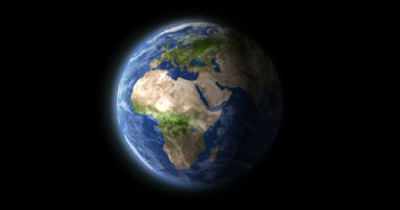
Our planet is in constant flux. Earth’s poles are shifting. The magnetic field is dropping in strength. Gold is seeping out of the core. We might not notice it in our daily lives, but the world that we call home is shifting and developing in ways that science doesn’t fully understand. New oceans spring up, sea currents disappear, and waste morphs into rocks, to name just a few.
Here are ten of the astounding ways that our planet is evolving, whether we like it or not.
Related: 10 Strange Facts about the Planet Mercury
10 Magnetic Field Weakening
There’s A “Bermuda Triangle” In Space | Answers With Joe
Earth’s magnetic field is growing weaker. Our planet is surrounded by vast, shifting forces that keep us shielded from solar particles and cosmic rays. It often varies in power and direction, but scientists have noticed a worrying downward trend in the field’s strength.
Over the past 200 years, the global average field strength has dropped by 9%. One of the most affected regions is the South Atlantic Anomaly, which stretches between Africa and South America. Since 1970, the field strength in that area has fallen by 2,000 nanoteslas, while the region itself has expanded and drifted to the west. What’s more, satellite data indicate that a second area of low field strength is opening up over southwest Africa. Scientists believe that the South Atlantic Anomaly could be about to split in two. [1]
9 Polar Vortex Shifting
What the Polar Vortex Will Do to Earth this Decade
The polar vortex is stretching, leading to a rise in extreme cold weather over North America. Scientists say the region of low pressure hovering above the Arctic is on the move. Alterations are causing the vortex to stretch and warp, sending whirls of freezing air over Canada and the US. Scientists say the rise in severe winters, heavy storms, and deep snow is linked to changes in the polar vortex.
In a 2025 study, scientists probed polar winds in the stratosphere—the middle region of the atmosphere that lies 12 miles above the Earth. They found that over the last 40 years, the vortex has often wobbled and deformed, frequently driving cold weather over North America. Experts reckon that changes in the vortex might be related to exceptionally cool periods in the Pacific Ocean known as La Niña. But so far, nobody can explain why the two events seem to coincide. [2]
8 Atlantic Currents Declining
This Is The Best Evidence That Atlantic Currents Are Slowing (AMOC Explained)
Key currents in the Atlantic Ocean are slowing down, and scientists warn that this collapse could be driving an increase in extreme weather. A vast web of marine streams known as the Atlantic Meridional Overturning Circulation (AMOC) is in decline.
These currents help regulate the world’s climate. They act as a sort of oceanic conveyor belt along which heat, carbon, and nutrients travel from the tropics to the Arctic Circle. However, scientists say that AMOC is weakening and could be about to shift sharply. If this happens, it will be the currents’ first major change in over 10,000 years. Studies reveal that AMOC has already dropped by 15% since 1950.
Researchers are now trying to work out what the Atlantic circulation’s future looks like. Some believe it could be about to collapse at any point over the next 70 years, while others say the system is “very unlikely” to undergo major changes this century. If it does collapse, computer models suggest that Atlantic sea levels could surge as high as a meter. The Amazon’s wet and dry seasons may also switch over, and global temperatures are likely to go haywire.
“What surprised us was the rate at which tipping occurs,” said Utrecht University’s René van Westen, who led a study into saline levels in the Atlantic. “It will be devastating.” [3]
7 North and South Poles Shifting
What the Upcoming Magnetic Flip Will Do to Earth
Believe it or not, humans have stored so much water in dams that it has altered the position of the Earth’s poles. The North and South Poles are now both slightly misaligned with the axis of rotation thanks to the weight of the aqua pressing down on the planet.
People have built nearly 7,000 dams since 1835. Enough water is stored behind these levees to fill the Grand Canyon twice. The combined weight causes the Earth’s rocky outer layer to shift and wobble. This causes the poles to bob about, which scientists describe as true polar wander. Over the past nearly 200 years, the poles have drifted around a meter (three feet), while global sea levels have trickled down by 21 millimeters.
From 1835 until the mid-20th century, there was a boom in dam building across North America and Europe. This caused the North Pole to wander 7.9 inches (20 cm) in the direction of Russia, Mongolia, and China. After that, Asia and East Africa started getting in on the act, which shifted the pole over half a meter toward the west. In total, the North Pole has traveled around 3.7 feet (113 cm) in just under two centuries. [4]
6 New Ocean Forming
A New Ocean Is Forming in Africa
Leave a Reply