
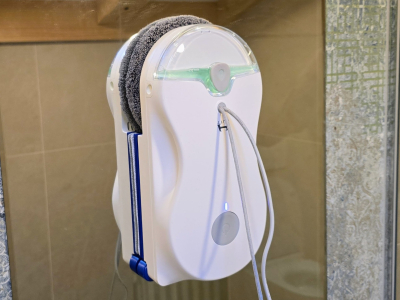
The Hutt 10 impresses with its ease of use and reliable navigation across surfaces. It also impresses with its edge detection and versatility. In addition to windows, the robot also cleans shower enclosures and mirrors. The cleaning results are good, even if the Hutt 10 sometimes leaves behind residue.
Operating the Hutt 10 is incredibly simple. There is just one large button on the unit. Once the device is plugged in, a long press of the button is all it takes for the robot to adhere to a window or other vertical surface using suction. A short press starts the cleaning program.
This means the robot is ready for use within seconds. The included remote control offers more options. Using a directional pad, the Hutt 10 navigates to the edges, where spot cleaning is possible. The remote control also allows you to switch between wet and dry modes.
You can also choose between standard and intensive cleaning modes. There’s a single button for each mode; pressing it once switches between the functions. There’s no display showing which program is currently running. Hutt does not include an app connection.
The cleaning cloths are easy to replace and wash. The square “polishing cloth” can be used on both sides. Removing the cloths is a breeze. However, attaching the round cloth to the window takes a bit of practice.
In testing, the robot reliably stays on vertical surfaces. If there’s a power outage or someone accidentally unplugs it, the robot can keep running on its built-in battery—while emitting a warning sound. Cleaning isn’t possible in emergency mode.
ⓘ Benedikt Winkel
The Hutt 10 is operated via a central button and the remote control ⓘ Benedikt Winkel
The cleaning wipes can be easily removed and washed
ⓘ Benedikt Winkel
The cleaning solution level is clearly visible ⓘ Benedikt Winkel
An empty bottle makes it easier to refill the cleaner.
ⓘ Benedikt Winkel
The Hutt 10 comes with three cleaning wipes. ⓘ Benedikt Winkel
The Hutt has 10 nozzles for the cleaner on both sides
ⓘ Benedikt Winkel
The Hutt 10 must be plugged into an outlet to operate; the power supply is large. We tested the Hutt 10 on windows, mirrors, and shower partitions. Unfortunately, it did not work on a skylight, even though the manufacturer claims it should. The angle was likely too shallow.
The robot impresses with its edge detection. The Hutt 10 recognizes not only window frames but also the edges of mirrors or frameless shower walls. On frameless glass surfaces, the robot moves right over the edge, leaving no area uncleaned.
Another positive aspect is its ease of use—the robot is ready to go right away and doesn’t need to be paired or initialized. For cleaning, we first used only water, and later a mixture of water and glass cleaner. We were surprised that the Hutt 10 effortlessly reaches areas that are difficult to clean by hand, such as narrow spaces or high windows.
The robot has trouble with heavily soiled windows. These should be roughly cleaned beforehand, or the Hutt 10 will need multiple passes—and the cloths should be cleaned in between. For normal dirt like dust, fingerprints, and rain streaks, the results are impressive.
However, the cleaning results aren’t perfect. During our test, we noticed on several occasions a permanent mark left by the round cleaning disc at the starting or ending position where the robot attaches itself. On one window, the mark left by the roller drive was visible after cleaning. Both can be easily removed with a cloth.
Technology and journalism have always come together in my past. However, it was mostly cars and motorcycles that I put under the microscope. Since my active triathlon days, I’ve been a fan of sports watches and smartwatches – triathlon is history for me, but the enthusiasm for watches is still there. That’s why, in parallel to my dissertation in theology, I write at Notebookcheck mainly about smartwatches, but also about other news and technology that interests me.
Leave a Reply