
Holden Henry/Getty Images
We may receive a commission on purchases made from links.
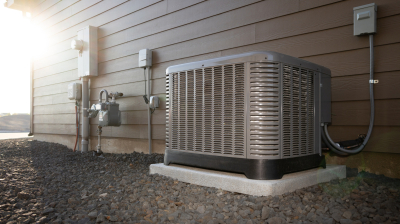
Few things are more precious to homeowners than a functional HVAC unit. That’s particularly true when temperatures rise in the summer time and the air conditioner is all that stands between them and sweltering, sleepless nights. Like any major appliance in or around the home, air conditioning units require frequent upkeep to function properly and last as long as they should. That’s true whether or not they are connected directly to an HVAC system.
Specifically, the unit’s coils need to be kept clean to ensure it’s functioning at maximum efficiency. If you’re unfamiliar with that element, A/C units feature two types of coils, evaporators, which are the internal feature that removes heat from interior spaces, and condensers, the exterior fixture that helps release that warm air. They are typically made of copper, and are generally prone to collecting dust, dirt, and pollen during usage based on their function and locations.
Failure to clean those coils can result in reduced comfort and capacity, as well as increased wear on the system. Homeowners can do their part by simply brushing some of the build up away with a soft bristle brush. Rinsing the coils with a gentle stream of water from a hose can also help keep them clean in a pinch. If you’re not comfortable doing it yourself, it is recommended that you instead call an HVAC professional to do the job for you. And yes, you’ll want to do it on a fairly regular basis.
How often to clean your A/C coils and how to do it
Wissawa Chamaboon/Getty Images
Your air conditioning unit’s coils should be cleaned at least once a year, though in coastal and desert regions biannual cleanings may be recommended. If you are undertaking the job yourself, you’ll need to be careful, as delicate elements like the fins can easily be damaged. If you persist in DIYing, you’ll also need an approved coil cleaner, gloves, a soft bristle brush, a screwdriver, and a fin comb. With those items in hand, follow these steps to clean your unit’s condenser coils:
Turn off the power to your A/C unit, doing so at the breaker instead of the thermostat.
Remove the covers from the condenser unit.
Clean excess dust and debris from around the unit, then use the soft bristle brush to gently remove build up from the coils. A shop-vac with soft-bristle attachment may also work here.
If you see bent fins, use the fin comb to straighten them.
Apply the coil cleaner and let it sit as long as the directions recommend.
Use a hose with spray attachment to gently rinse the cleaner from the coils.
The cleaning process is generally the same for the inverter coils inside the A/C unit’s interior component, as well as window or portable units, though you’d be wise to use a spray bottle to rinse the cleaner from those units instead of a hose. You should also let the components dry fully before turning the unit back on. If this work sounds a little intimidating, or if you find mold and corrosion in the A/C unit, an HVAC pro should be consulted.
Signs your A/C coils need to be cleaned
J.J. Gouin/Shutterstock
Now that you know the how’s and when’s of keeping your air conditioner’s coils clean, you might be thinking about other signs indicating that they need to be. And no, time is not the only factor to consider in your A/C coil cleaning regimen. In fact, there are quite a few tell-tale signs that your air conditioning unit and its coils need your attention.
Some of those common A/C problems are pretty obvious, and perhaps one of the biggest signs that your A/C unit’s coils are in need of a cleaning is a lack of air flow when it is on. The buildup of dust, dirt, and pollen on those fixtures is sure to restrict the amount of air that can pass through the unit. So, if you’re noticing a lack of air flow, it might be time to clean. Ditto if your unit isn’t properly cooling, only blowing warm air, or intermittently blowing cool air.
Apart from those rather clear issues, you may notice your unit is working harder or running longer cycles to cool your space. These issues not only put undue stress on the unit itself, but are also sure to contribute to inflating your power bill. Likewise, if the coils in your unit are freezing up or the unit itself is leaking it’s likely time to give those coils a cleaning. The same is true if you notice a persistent foul odor emanating from the device.
Leave a Reply