
Published Jul 19, 2026, 8:45 AM EDT
Tim has been covering technology for almost 20 years, in that time spanning a broad range of topics from security to product reviews. He is especially focused on the Apple ecosystem, productivity, and consumer advice.
Over the years Tim has written thousands of articles, reviews, and round-ups in addition to producing video content and original photography. A graduate of journalism, he found his footing as a freelancer with a laptop and loves how he is able to work from practically anywhere.
Now a Senior Editor for iPhone, Mac, and Smart Home at How-To Geek, Tim still loves to write. He can also be found crafting round-ups and productivity posts for the Zapier blog.
Earlier in his career Tim spent nearly a decade as a writer and eventually Apple section editor for MakeUseOf.
Tim currently lives in Brisbane, Australia. Outside of work he loves to hike and work out, play video games, and spend quality time with his wonderful partner and two cats Inka and Roger.
If you don’t have sensors hidden all over your house, do you really have a smart home? These devices make it possible to use all sorts of useful automations and alerts, from turning on lights to avoiding thousands of dollars worth of damage.
Here are four sensors you should probably put in your home’s darkest, dampest, and coldest places.
Water leak sensor
Where there are pipes, there’s danger
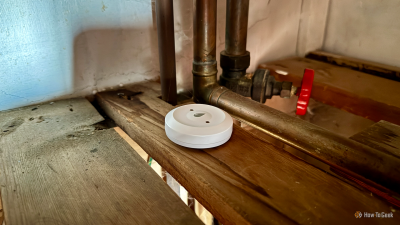
Water leak sensors are arguably the most valuable sensors you could ever install. Like a smoke alarm, they’re the sort of sensor that you hope you’ll never need, but they pay for themselves many times over in terms of value for money and peace of mind.
A $10 sensor like the IKEA Klippbok could save you thousands of dollars in property damage, prevent your insurance premiums from rising, and avoid all the disruption that comes along with lengthy home repairs. As one How-To Geek writer discovered, you need more than one of these sensors to do the job (putting them underneath the sink might not be enough).
A water leak sensor in the basement could catch pooling water that might be present in the event of heavy rain. Putting a few in the attic could detect a roof leak before it becomes a serious problem. Scattering them around your home wherever pipes could burst is particularly useful if your home gets very cold in the winter.
Advanced warning is nice, but a water leak sensor might not be enough. Pair one with a water cut-off valve (or actuator) for ultimate peace of mind.
IKEA Klippbok water leak sensor
Connectivity
Matter over Thread
Wi-Fi
No
This water leakage sensor keeps track of water leaks by beeping when it comes into contact with water – helping you make life at home smoother, more comfortable and safer. When connected to a hub, the sensor sends a notification to your smartphone with information about the water leak. The small size makes it easy to position under the sink, appliances or other places where a water leakage can occur.
Humidity sensor (hygrometer)
Detect moisture before it becomes a problem
Credit: Aqara
Humidity can cause all sorts of problems, no matter the season. In the summer, moist air can lead to rapid mold growth. In the winter, it can make it harder to heat your home. A hygrometer, or humidity sensor, can help detect moist air so that you can do something about it.
Some parts of your house, like the basement, may be more susceptible to damp than others. Use a humidity sensor to set up an automation that automatically turns on a dehumidifier whenever a threshold is met. You can even use Home Assistant to set up a mold detection helper.
Similarly, excessive moisture in your attic could indicate the presence of a leak that doesn’t let in enough moisture to trigger a leak sensor, but that can still cause problems.
Aqara Zigbee Temperature and Humidity Sensor (3-Pack)
Dimensions (exterior)
36x36x9 mm
Compatibility
Apple Home, Aqara Home, Home Assistant (via ZHA or Zigbee2MQTT)
This small but mighty Zigbee sensor can measure both temperature and humidity. It’s battery-powered, so you can place it almost anywhere. You’ll need an Aqara hub to use it with the native app, or you can connect it directly to Home Assistant using integrations such as Zigbee2MQTT.
Temperature sensor
Fix insulation blind spots and avoid frozen pipes
You probably have temperature sensors connected to your heating and cooling system, or an air quality sensor in a central part of your home. These are key to setting and maintaining a comfortable temperature within your living area. But what about everywhere else? Old houses in particular have poor insulation and are highly susceptible to temperature drops in the winter.
But you won’t know about it until it’s too late. Throw a few temperature sensors down and monitor the temperature of the parts of your home that you don’t spend a lot of time in. Think of it as a data-gathering exercise, where you figure out where your insulation blind spots are and where the best place is to install pipe insulation, seal drafts, or even add a few space heaters.
IKEA TIMMERFLOTTE
The IKEA TIMMERFLOTTE is a puck-shaped temperature and humidity sensor. The device comes with Matter-compatibility, allowing it to connect to your smart home hub of choice. It’s powered by two AAA batteries.
Movement and presence sensors
Trigger the lights and spot critters
Credit: Tim Brookes / How-To Geek
I used to live in a very old house that had a decent-sized attic. Occasionally, I’d forget to turn the light off up there, and this would give me the illusion that something was lurking in the attic. Sometimes it would be weeks before I’d realize.
If I was still in that house, I’d stick a load of presence sensors down to handle lighting for me. In particular, I’d use combined infrared and mmWave sensors like the Everything Presence One ($65) to get the best of both worlds. Infrared is particularly good at sensing sudden movements, while mmWave excels at presence detection to prevent the lights from going off when you’re still in the space.
In addition to making it easier to venture into the darker, spookier parts of your home, you can also set up an alert that sends you a notification when movement is detected. That way you’ll know that you are sharing your home with furry or feathered visitors. If you have a particularly creative imagination, you might want to avoid doing this for fear of scaring yourself—or at least add a camera so you can check without going up there yourself.
Everything Presence One
This ultimate smart home sensor supports a 24GHz mmWave Sensor for precise motion tracking as well as a powerful PIR for lightning fast responses. With a Temperature and Humidity sensor for monitoring climate status, Ambient Lighting sensor for smart control of lights, Bluetooth Tracking for wearables and an ESP32 for connectivity.
Don’t forget to change the batteries
Sensors only keep working for as long as they have charge (or are connected to power). Since most of these are battery-powered, changing the batteries regularly and testing your sensors is a must.
If you’re feeling particularly frugal, you can substitute retail sensors for DIY sensors made with an ESP32.
Leave a Reply