
TL;DR
ERC System unveiled its Victor cargo eVTOL at ILA Berlin 2026, targeting 250kg payload, 300km range, and 2028 deliveries for defence and logistics.
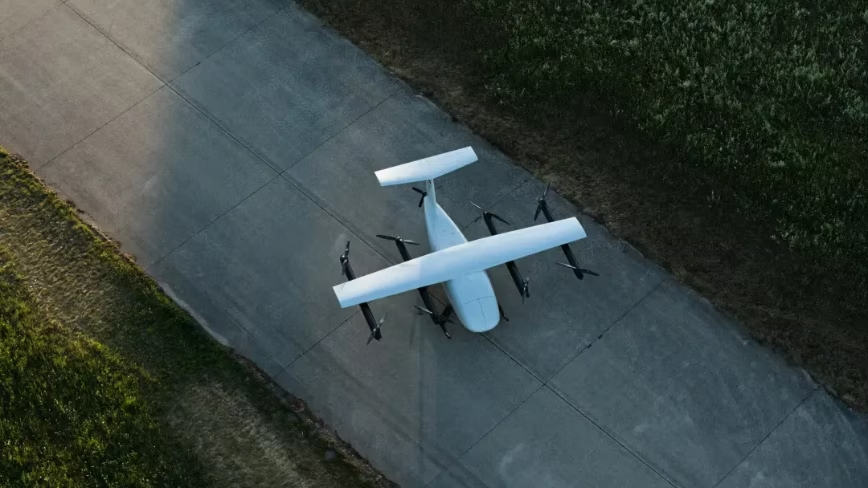
Munich-area startup ERC System has unveiled Victor, an uncrewed hybrid-electric cargo eVTOL designed for defence, logistics, and disaster response, at ILA Berlin 2026. The company says the aircraft can carry a 250kg payload over a range of 300km at a cruise speed of 250km/h. ERC System is targeting first deliveries in 2028.
Victor uses a lift-and-cruise architecture with eight lifting propellers for vertical takeoff and a pusher propeller for forward flight. A piston engine serves as a range extender on top of the electric powertrain, a design choice that ERC’s chief commercial officer Maximilian Oligschläger has said reflects the company’s reluctance to “bet on future technologies.” The hybrid approach trades the simplicity of a fully electric system for the range that battery technology alone cannot yet deliver.
The aircraft builds on flight testing of ERC’s Romeo prototype, a 2.7-tonne, 16-metre-wingspan demonstrator that the company says is the heaviest fully electric aircraft of its type to have flown in Europe. Romeo began hover testing near Munich in November 2025, completing roughly ten flights. ERC says the tests validated its flight-control system and lift-and-cruise configuration.
The 💜 of EU tech
The latest rumblings from the EU tech scene, a story from our wise ol’ founder Boris, and some questionable AI art. It’s free, every week, in your inbox. Sign up now!
ERC System was founded in 2019 in Ottobrunn, just outside Munich, by Christopher Schrop, Maximilian Oligschläger, and three other co-founders. The company emerged from stealth in July 2024 and is backed by IABG, a German aerospace testing and certification specialist that serves the Bundeswehr. IABG has invested what has been described as a “significant double-digit-million-euro sum” and remains ERC’s sole institutional backer.
The company claims Victor’s direct operating costs will be roughly 70% lower than those of a small helicopter. That figure has not been independently verified, and no uncrewed eVTOL of this size has yet operated commercially in Europe, making the comparison speculative. The aircraft’s modular interior can be configured for cargo, medical supplies, or mission-specific equipment, with rear clamshell doors for loading.
Victor’s 250kg payload, 300km range, and 250km/h cruise speed are company specifications that have not been demonstrated in flight testing. The specs were disclosed at ILA Berlin and have not yet been independently confirmed. German dual-use drone makers like Quantum Systems have attracted substantial investment in recent years, but ERC’s cargo eVTOL occupies a different category, heavier and slower than military surveillance drones but designed for sustained logistical operations.
ERC is also developing Charlie, a crewed eVTOL for inter-hospital patient transfers, which it expects to enter service around 2031 in collaboration with German air rescue operator DRF Luftrettung. The company frames Victor as a near-term revenue generator while the longer and more complex certification process for a piloted aircraft plays out.
The 2028 delivery timeline is ambitious by the standards of an industry that has repeatedly missed its own deadlines. At least six European eVTOL manufacturers have entered insolvency since 2023, including Lilium and Volocopter. Defence drone startups like Berlin’s Stark have attracted billions in capital, but the transition from prototype to serial production remains the defining challenge for the sector.
ERC has no revenue, no certified aircraft, and no publicly disclosed customer contracts. It is competing for defence and logistics customers against established players with operational track records, including Dronamics, which already holds a European cargo drone licence, and military drone manufacturers with active deployments in Ukraine. What ERC does have is a flying full-scale prototype and a strategic investor with deep roots in the German defence establishment, which may matter more than venture capital in a market increasingly shaped by government procurement.
Leave a Reply