
Cities are heavy. Take New York, for example. America’s most populous city has almost 1.1 million buildings weighing roughly 1.68 trillion pounds (764 billion kilograms).
New York City is sinking. But the Big Apple’s fate is not a lonely one; it has plenty of unfortunate companions. All over the world, the soil can no longer support our rapidly growing metropolises, and many are now being consumed by marshes, mines, or compacting soil.
The cities include historical sites and capitals, and most are home to millions of people. The phenomenon threatens their homes and cultural heritage alike. While most of the cities on this list might suffer serious damage to infrastructure before a solution can be found, not every case is so bleak.
In New Delhi, a grassroots movement is trying to save the city with rainwater, and the Swedish government is moving Kiruna, a city near the Arctic Circle, back to solid ground—brick by brick.
Related: 10 Modern Cities That Are Actually Built on Ancient Ruins
10 Mexico City, Mexico
Why Mexico City’s Geography SUCKS
The Mexican capital, Mexico City, is home to 22 million people. This sprawling city also covers 3,000 square miles (roughly 7,800 square kilometers) of what was once an ancient lake bed, making it one of the biggest and most densely populated urban areas on Earth.
In 2026, NASA revealed that Mexico City is also one of the fastest-sinking metropolises in the world—falling by nearly 10 inches (about 25 centimeters) a year in some areas.
After actively sinking for over a century, many of the city’s older buildings are now leaning to one side. Some important landmarks even require constant intervention. For instance, over the years, the Angel of Independence monument received 14 additional steps as the earth around the base continues to sink. Critical infrastructure, including homes, streets, the drainage system, and the water system, is also being damaged.
Like so many other cities in the same predicament, Mexico City is sinking mainly due to heavy urban development on soil that is becoming increasingly unstable from excessive groundwater removal. In other words, adding more weight on “soft” soil…and it’s no wonder that Mexico’s capital is facing a grim future. [1]
9 New Orleans, United States
Why No One Can Save New Orleans From Sinking
In 2005, Hurricane Katrina devastated New Orleans. The storm drew attention to the city’s vulnerability against the ocean, but it also exposed another problem—New Orleans is slowly sinking. Scientists cannot agree on why this is. Still, geologists have blamed groundwater removal, oil drilling, and soft soil for most of the region’s issues. But in 2006, a geologist named Roy Dokka suggested that nature, not humans, was the main culprit.
Dokka studied the Michoud area, which is free of any type of mining. Even so, it suffers one of the highest sinking rates in the south-central United States. To discover why, Dokka examined 50 years of NOAA (National Oceanic and Atmospheric Administration) surveys of the Michoud.
The surveys recorded data about a steel well that reached about 1.3 miles (2,000 meters) deep. The well showed that the area was sinking about 0.6 inches (1.5 cm) a year between 1969 and 1971, and then at a slower rate of 0.27 inches (0.7 cm) a year between 1971 and 1977.
Since all human activities, like drilling and natural land settling, occur above the well’s depth, any sinking is likely caused by tectonic movement. Supporting this theory is the fact that the Michoud sits on a 4.3-mile (7-km) deep fault. Dokka estimated that 50% to 73% of the sinking recorded by NOAA was caused by the moving crust, and the rest by draining or compacting soil. [2]
8 Chicago, United States
Chicago is sinking: Research shows heat has contributed to sinking ground in Chicago
Chicago isn’t the speediest of the sinking cities. Over the last 100 years, the Windy City has lost about 4 inches (10 cm), and over the next century, it will sink at the same rate. This sounds safe enough. But in reality, this tiny drop can interfere with the effectiveness of the city’s sewer system and increase the risk of flooding.
For now, the city cannot do anything about the steady downward movement. The problem is simply too old and big. Chicago’s fate was sealed thousands of years ago when ice sheets blanketed most of North America. Some were miles thick, and this weight warped the Earth’s crust. Around 10,000 years ago, the last of the glaciers receded. Free from the crushing weight, the crust could now bounce back, but this process isn’t instant. It can take millennia.
To understand why Chicago is not lifting into the air, one must look to Canada. Here, the ice sheet was the heaviest. When the ice disappeared, a lot of crust material flowed back into this region. Chicago is located where this material is leaving to flow back under Canada, thus sinking the city. [3]
7 Venice, Italy
Why Venice is SINKING Irreversibly
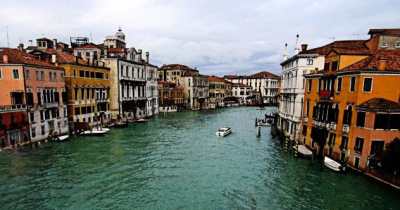
Not all sinking cities are slowly disappearing into the soil. Some drown. A famous example is Venice, a UNESCO World Heritage site located in Italy. Venice is iconic for its canals and romantic gondola rides, and, ironically, rising sea levels could threaten this city within 300 years if no solution is found.
Saving the so-called “floating city” is no small task. Rising water is not the only problem. The very land that Venice rests on is also sinking. Some options might keep the 1,600-year-old city safe from the rising sea, at least. These include ring dikes, portable barriers, closing the Venetian Lagoon, and relocating the entire city. However, these solutions aren’t perfect.
Moving every house, monument, and resident would cost €100 billion. Closing the lagoon will permanently shut down Venice’s port, and only protect the city until the year 2300, when sea levels are expected to reach 4.1 feet (1.25 meters). Ring dikes can block water up to 20 feet (6 meters) high, but they will cost billions, sever the city’s connection with the lagoon’s ecosystems, and kill the cultural vibe that tourists pay for. [4]
6 Tehran, Iran
Tehran: The Sinking Capital in the Middle of a War
Leave a Reply