
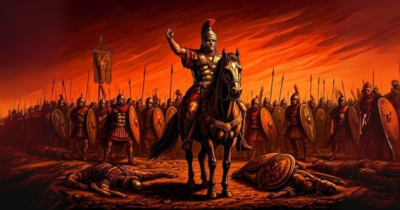
Ordinarily, battles and wars are won by long-term preparation, military concepts, methods and the weapons available to both sides. While the outcome of battles could be predictable due to the level of preparation of one party compared to the other, for instance, a country with a thousand military aircraft is expected to triumph easily if it picks a fight with one with a hundred and fifty aircraft.
While simple mathematics would usually prevail in this type of equation, trickery is a factor that can flip the equation in favor of a party nobody expected to win. This is usually sensational when it happens.
These are ten times trickery won battles:
Related: 10 Often Forgotten Battles That Helped Shape the Modern World
10 Hannibal’s Double Envelopment at the Battle of Cannae
Battle of CANNAE 216 BC: Hannibal’s Masterpiece
The Battle of Cannae, fought in 216 BC during the Second Punic War, stands as a masterclass in battlefield deception. Despite facing overwhelming Roman numbers, Carthaginian general Hannibal Barca used cunning tactics and strategic manipulation to orchestrate one of the deadliest ambushes in military history.
After crossing the Alps with his army and war elephants, Hannibal won a series of victories, including at Trebia and Lake Trasimene. In response, Rome assembled a massive army—nearly 80,000 infantry and 6,000 cavalry—under the joint command of consuls Lucius Aemilius Paullus and Gaius Terentius Varro. Hannibal had about 40,000 infantry and 10,000 cavalry, significantly outnumbered.
But what he lacked in manpower, he made up for in planning. He deliberately chose the battlefield near Cannae, where flat terrain favored cavalry maneuvers and wind-blown dust from the sea would hinder Roman visibility. He also knew the Romans were impatient and eager to crush him in open battle.
Hannibal arranged his troops in a crescent formation, placing his weaker Spanish and Gallic infantry in the center, with his stronger African veterans positioned at angles on either flank. His cavalry was divided on both wings, with his brother Hasdrubal on the left and Hannibal coordinating the entire force.
As the battle began, the Roman army, under Varro’s command that day, drove forward in a dense column to smash through the Carthaginian center. The center gave ground and gradually fell back—seemingly on the verge of collapse. But it was all part of the plan. As the Roman legions surged into the center, the African infantry on either flank pivoted inward, forming a U-shaped pocket. At the same time, Hasdrubal’s cavalry routed the Roman horsemen and wheeled around to strike from the rear.
The result was a textbook double envelopment. The Romans were trapped on all sides—pinned front and back, flanked on both sides, and hemmed in with no room to maneuver. In the choking dust and chaos, Roman formations crumbled. The slaughter was immense. Of the 80,000 Romans who entered the battle, as many as 50,000 to 70,000 were killed in a single day. Only a few thousand escaped. Consul Paullus was killed; Varro fled with a small remnant. Carthaginian losses were minimal by comparison.
Hannibal’s victory at Cannae remains one of the greatest tactical feats in history. His use of deception, terrain, and enemy psychology turned inferior numbers into overwhelming triumph. [1]
9 The Feigned Retreat at the Battle of Hastings
Was William The Conqueror’s Retreat Real or Feigned?
The Battle of Hastings, fought on October 14, 1066, was a pivotal clash between the Norman forces led by William, Duke of Normandy, and the English army under King Harold Godwinson. One of the most decisive tactics that led to William’s victory was the feigned retreat, a deceptive maneuver that lured the English troops out of their strong defensive positions and ultimately broke their shield wall, sealing the fate of the English army.
At one point during the battle, a section of the Norman cavalry apparently broke ranks and began to flee downhill from the battlefield. The English, believing they had won or that the enemy was in full retreat, broke their disciplined formation and pursued them down the slope.
This was exactly what William had planned. The “retreat” was a ruse—a deliberate tactic designed to lure the English off the high ground and away from their defensible position. Once the English had pursued the fleeing Normans far enough, the Norman cavalry suddenly stopped, turned around, and counterattacked the now-exposed and disorganized English soldiers.
This sudden reversal caught the English off guard. The tightly knit shield wall was broken as soldiers became separated and vulnerable. The Norman cavalry and infantry then exploited the gaps to inflict heavy casualties and push the English lines back. This feigned retreat was reportedly repeated multiple times during the battle, each time drawing more English men into pursuit and gradually eroding the shield wall’s strength. Over time, the discipline and cohesion of the English forces crumbled, making them easier targets for the Normans.
In the end, William’s victory at Hastings led to the Norman conquest of England, transforming English culture, language, governance, and society. [2]
8 Japan Bluffed Their Way to Victory in the Battle of Singapore
130 – Britain’s Worst Defeat – Singapore Falls – WW2 – February 20, 1942
The Battle of Singapore, fought from February 8 to 15, 1942, was one of the most stunning defeats in British military history. Despite being outnumbered and undersupplied, the Japanese used speed, deception, and bold tactics to capture what was considered an “impregnable fortress.” Central to their victory was a strategic bluff that convinced the British they faced a far larger force than they actually did.
British commanders, led by Lieutenant-General Arthur Percival, expected a naval attack on Singapore’s heavily fortified southern coast. However, the Japanese, under General Tomoyuki Yamashita, crossed from the north, through the Johor Strait, where defenses were weakest. Yamashita had roughly 30,000 to 35,000 troops, while the British, including Australian, Indian, and local units, numbered around 85,000. Knowing he lacked the manpower and supplies for a prolonged battle, Yamashita relied on bluff and psychological warfare.
He launched bold attacks with loud noise, rapid movements, and deception to give the impression of overwhelming strength. Japanese troops lit numerous campfires, spread out to seem more numerous, and frequently changed positions to simulate troop rotations.
In addition, the Japanese used false radio traffic and staged communications to suggest reinforcements were arriving. Yamashita sent an ultimatum demanding surrender. Percival, believing he was surrounded by a massive force and fearing civilian casualties, chose to surrender—unaware he was giving in to a much smaller force that was short on ammunition and supplies. [3]
7 Operation Fortitude
WW2’s Greatest Deception: Operation Fortitude
Operation Fortitude was a critical deception campaign conducted by the Allies during World War II to mislead the German military about the location and timing of the D-Day invasion. This operation played a vital role in ensuring the success of the Allied landings in Normandy on June 6, 1944.
Operation Fortitude was divided into two main parts: Fortitude North and Fortitude South. Fortitude North aimed to convince the Germans that the Allies would invade Norway, while Fortitude South was designed to make them believe the main invasion force would land at Pas de Calais, the narrowest point between Britain and France, rather than Normandy.
To execute this deception, the Allies used a combination of fake equipment, dummy landing craft, double agents, and misleading radio traffic. A key element of Fortitude South was the creation of a fictitious First U.S. Army Group (FUSAG), supposedly led by General George S. Patton, one of the most respected and feared Allied commanders. Inflatable tanks, fake camps, and fabricated orders created the illusion of a massive force preparing to strike at Calais. Double agents such as Juan Pujol García (codename “Garbo”) fed false intelligence to the Germans, reinforcing the narrative that the Calais region was the true target.
The Allies also staged dummy radio transmissions and leaked misleading plans to ensure the Germans remained convinced of this alternate scenario. As a result of Operation Fortitude, the Germans held back significant forces in the Pas de Calais region even after the Normandy landings began. Believing that the Normandy invasion was a diversion, German high command delayed sending reinforcements, expecting a second, larger attack at Calais.
This hesitation allowed the Allies to establish and expand their beachhead in Normandy with less resistance than they would have otherwise encountered. [4]
6 Double Bluff and Feint Retreat at the Battle of Cowpens
Revolutionary War Genius: The Battle of Cowpens Explained #history
Leave a Reply