
Research Briefing
Published: 03 March 2025
Nature Biotechnology
(2025)Cite this article
Subjects
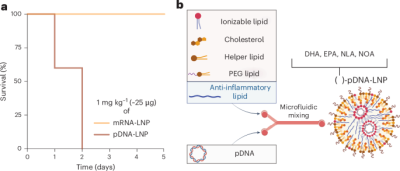
DNA delivery using lipid nanoparticles results in severe toxicity in mice. However, we find that the incorporation of endogenous anti-inflammatory lipids into the lipid nanoparticles mitigates this toxicity and enables prolonged gene expression.
This is a preview of subscription content, access via your institution
Access options
Access Nature and 54 other Nature Portfolio journals
Get Nature+, our best-value online-access subscription
24,99 € / 30 days
cancel any time
Subscribe to this journal
Receive 12 print issues and online access
209,00 € per year
only 17,42 € per issue
Buy this article
Purchase on SpringerLink
Instant access to full article PDF
Prices may be subject to local taxes which are calculated during checkout
Additional access options:
Log in
Learn about institutional subscriptions
Read our FAQs
Contact customer support
Fig. 1: pDNA-LNPs induce mortality in mice.
References Tenchov, R. et al. Lipid nanoparticles — from liposomes to mRNA vaccine delivery, a landscape of research diversity and advancement. ACS Nano. 15, 16982–17015 (2021). This review describes LNP nanotechnologies, their applications and the global research effort for their development.
Article
PubMed
CAS
Google Scholar
Hou, X. et al. Lipid nanoparticles for mRNA delivery. Nat. Rev. Mater. 6, 1078–1094 (2021). This review discusses the design of LNPs for mRNA delivery and highlights preclinical and clinical studies of mRNA-LNP therapeutics for infectious diseases, cancer and genetic disorders.
Article
PubMed
PubMed Central
CAS
Google Scholar
Yu, L. & Liu, P. Cytosolic DNA sensing by cGAS: regulation, function, and human diseases. Sig. Transduct. Target. Ther. 6, 1–15 (2021). This review describes regulatory mechanisms that govern cGAS activation and highlights the role of cGAS activation in immune responses and human diseases including cancer and autoimmune disorders.
Hansen, A. L. et al. Nitro-fatty acids are formed in response to virus infection and are potent inhibitors of STING palmitoylation and signaling. Proc. Natl Acad. Sci. USA 115, E7768–E7775 (2018). This article identifies nitro-fatty acids as endogenously formed inhibitors of STING signaling and proposes their use for STING-dependent inflammation.
Article
PubMed
PubMed Central
CAS
Google Scholar
Nong, J. et al. Multi-stage-mixing to create a core-then-shell structure improves DNA-loaded lipid nanoparticles’ transfection by orders of magnitude. Preprint at bioRxiv https://doi.org/10.1101/2024.11.12.623321(2025). This preprint discusses the multi-stage-mixing manufacturing technology used to develop core-then-shell pDNA-LNPs, which showed improved delivery efficiency and transfection.
Download references
Additional information Publisher’s note Springer Nature remains neutral with regard to jurisdictional claims in published maps and institutional affiliations.
This is a summary of: Patel, M. N. et al. Safer non-viral DNA delivery using lipid nanoparticles loaded with endogenous anti-inflammatory lipids. Nat. Biotechnol. https://doi.org/10.1038/s41587-025-02556-5 (2025).
Rights and permissions About this article
Cite this article Improving the safety of lipid nanoparticle-based DNA delivery for extended gene expression.
Nat Biotechnol (2025). https://doi.org/10.1038/s41587-025-02600-4
Download citation
Published: 03 March 2025
DOI : https://doi.org/10.1038/s41587-025-02600-4
Leave a Reply