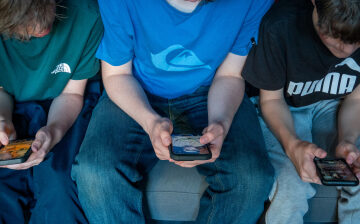
Matt Cardy/Getty Images Smartphone bans in the classroom might not be the panacea that governments and school administrations want them to be, according to a recently published study. As first reported by The New York Times , the National Bureau of Economic Research will publish a study called The Effects of School Phone Bans: National Evidence
FlashNews:
How big can the universe’s first starbursts get?
Anthropic says it blocked state-sponsored attempts to use Claude for bioweapons research
Why the CMO’s next chapter is becoming a true business
Space debris is multiplying, so satellite makers are building better ways to survive a hit
New European AI hub? Google invests €13 billion in Finland
Apple Watch Series 12 Vs. Ultra 4: Which New Smartwatch Is Right For You?
ASML targets 2033 for High-NA EUV with larger masks, promising a 40% productivity gain
The quantum deadline is unclear. The need to prepare isn’t.
Stoke Space raises $1 billion for fully reusable rockets, targets ‘early 2027’ for 1st-ever launch
Renault is building its €17,900 Dacia Spring EV in Europe to qualify for local subsidies
Samsung Electronics and ASML Expand Strategic Collaboration for Next-Generation Semiconductor
Linux isn’t lightweight by default—here’s what actually makes it work on old hardware
Android’s security switch locked me out of 5 Android features I actually use
Immaculate Engineering Meets Artistic Imagination: Highlights From Design Miami Seoul
What Is the Hottest Place on Earth? It Depends on What You Measure
Welcome to Your Keyboard-Free Future. This Jazzy AI Microphone Is All You Need Now
Site Is Closed on Sundays
A mysterious signal around Earth could be dark matter
1% of AI Users are 80% of Revenue and Usage
Home
Study
Tag: Study
Study: Conflicting values for Hubble constant not due to measurement
A long-standing tension — Something else is influencing the expansion rate of the Universe. Jennifer Ouellette - Mar 11, 2024 10:51 pm UTC Enlarge / This image of NGC 5468, about 130 million light-years from Earth, combines data from the Hubble and Webb space telescopes. NASA/ESA/CSA/STScI/A. Riess (JHU) Astronomers have made new measurements of the